


(Average reading time: 3 minutes)
Researchers from the FutureMS study have been highlighting the breadth of work being undertaken to improve our understanding of multiple sclerosis (MS). Over the past few weeks, the team have been presenting their latest research at major research meetings in the UK, including Northern Connections MS, SINAPSE 2026, and the MS Frontiers meeting.
During their presentations, the team showcased key discoveries from the study and outlined the next steps in its research priorities.
Exploring brain lesions and disease severity
We asked Francesca Pentimalli Biscaretti Di Ruffia, to tell us about her experiences. Francesca is a 3rd year PhD student supervised by Prof Adam Waldman, and co-supervised by Dr Peter Foley, Dr Rozanna Meijboom, and Dr Adriana Tavares.
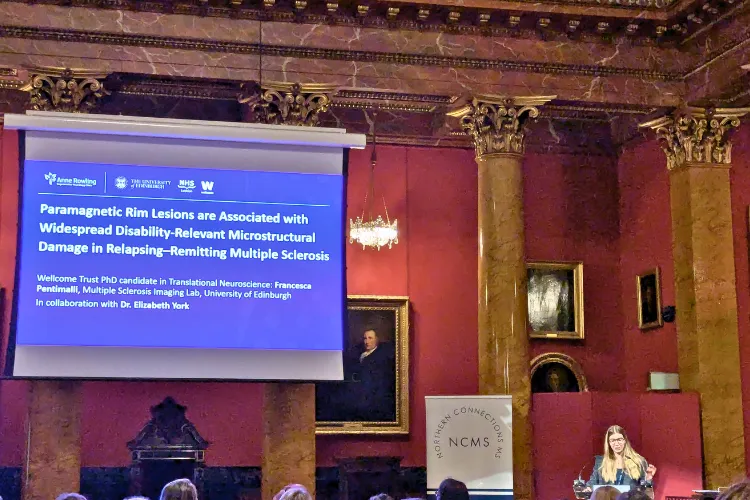
Earlier this month I attended the Northern Connections MS Meeting, which brought together researchers, clinicians and healthcare professionals to share new findings in MS research and care.
I gave a presentation on how a specific type of brain lesion may help identify more severe and widespread brain changes in people with MS.
I also presented this work at SINAPSE, a Scottish cross-disciplinary imaging network, where it was awarded the prize for best presentation in my session.
Different meeting experiences, complementary insights
What made this particularly rewarding was presenting the same work to two very different audiences: Northern Connections is a clinical conference, with conversations centred on what findings mean for patients and practice, while SINAPSE is more technical, with a sharper focus on imaging methods and analysis. Getting feedback from both angles really captures why I find this research so stimulating: it sits right at the intersection of clinical care and technical depth.
It was great to share this work and hear feedback from both the clinical and technical side. Events like this are energising: they bring the community together and remind you why sharing ideas and interdisciplinary work are crucial for advancing scientific knowledge.
Investigating links between pain and cognition
We also spoke with Dr Peter Foley, Consultant Neurologist and Honorary Clinical Senior Lecturer at the University of Edinburgh.
Dr Foley presented work from the FutureMS study at the recent 'MS Frontiers' meeting, an MS Society UK research meeting which runs every two years. This work focused on the links between pain, cognitive abilities, and medications in people who participated in the FutureMS study.
It was great to be able to present this new research to a wide audience of MS researchers, MS specialists and also people with MS at the MS Frontiers conference. We wanted to answer the questions "is pain linked to worse cognitive ability in people with MS?" and, if so, "could medications be the cause?". We hope that this work will help to draw new links between pain and cognitive abilities in people with MS. This may eventually lead to research which could benefit both pain control and perhaps even cognitive abilities in people with MS.
Recognition for patient and public involvement
We are delighted to announce that Peter and the wider FutureMS team won a good practice star from the MS Frontiers Scientific Committee for their work on PPI (Patient, public, involvement) in the FutureMS study.
The FutureMS Lived Experience Panel help shape the project and ensure that FutureMS continues to address questions that matter most to people living with MS.
A decade of discovery and the next phase of FutureMS
FutureMS is Scotland’s largest and most comprehensive study of people living with relapsing-remitting MS. Since recruiting more than 400 participants shortly after diagnosis, the study has generated valuable insights into the factors that influence disease progression and treatment outcomes.
The project has now entered its 10-year follow-up phase, with researchers re-engaging participants to understand how MS develops over the longer term and to identify predictors of future health outcomes.
Relevant links
Meet the FutureMS Lived Experience Panel
Find out how you can support our research
Northern Connections (external website)
MS Frontiers (external website)
SINAPSE network (external website)