FutureMS aims to answer questions that people with MS frequently ask their doctors.
Every person newly diagnosed wants to know how MS will affect them over their lifetime, what can be done to stop the condition progressing and how to maintain their quality of life. The FutureMS project aims to help answer those questions.
We want to develop tools that will allow individualised prediction of disease activity:
-
to understand why parts of Scotland are the world capital of MS
-
to examine the physical and mental impacts that MS will have on each person
-
to be able to offer the right drug treatment at the right time for that individual
Watch a 2-minute animation about FutureMS:
FutureMS: the journey
Multiple sclerosis is a long-term condition. To really understand the impact of MS on individuals, we need to not only map what happened to someone at the point of their diagnosis, but also to follow up these same individuals over time.
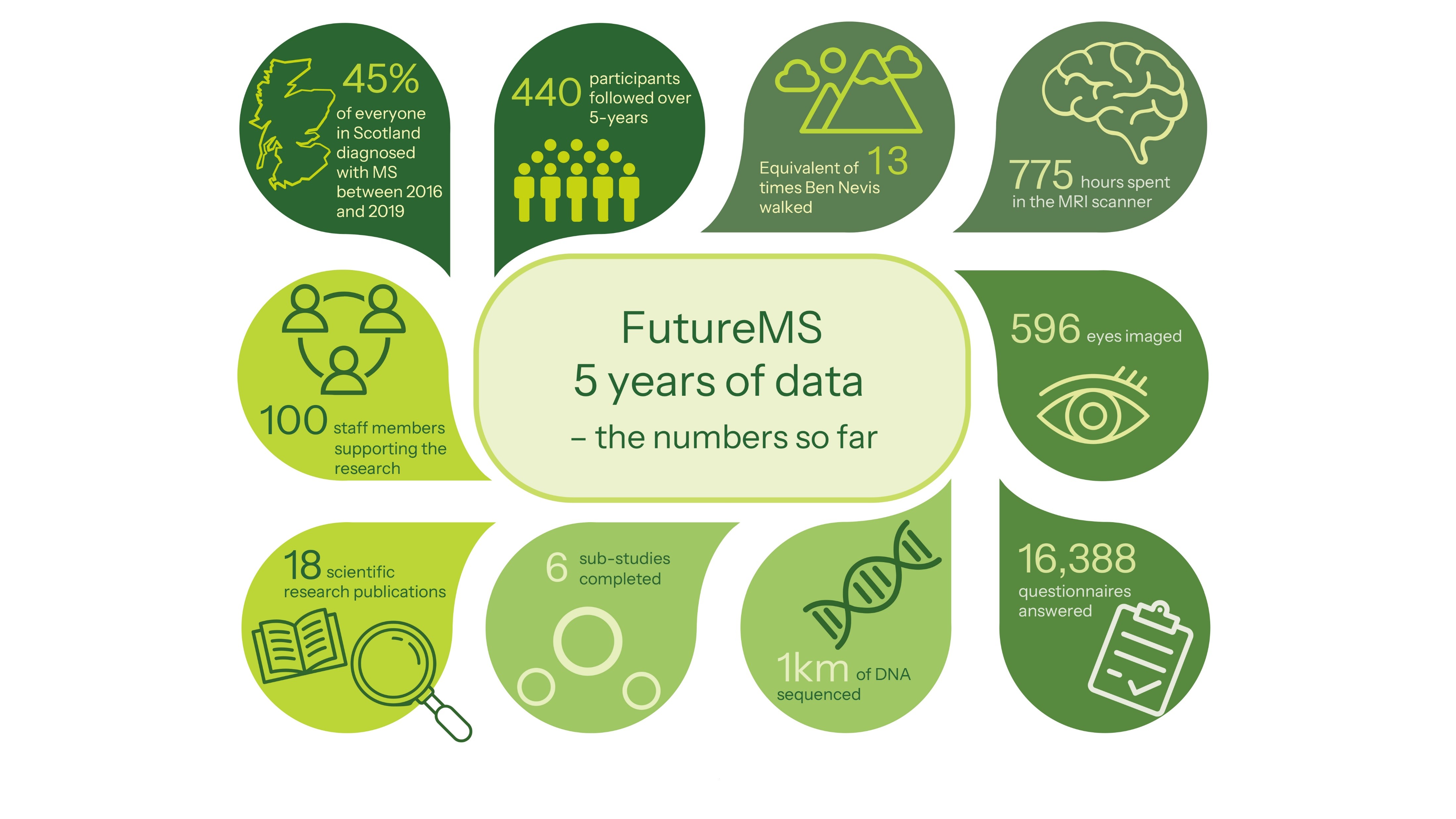
FutureMS is following the MS journeys of 440 people in Scotland who were diagnosed with MS between 2016 and 2019. Participants underwent tests shortly after diagnosis, and again 1 and 5 years later.
There are study sites in Aberdeen, Dundee, Edinburgh, Glasgow and Inverness.
A lived experience panel of people with MS is providing invaluable support and advice: helping to shape priorities, and make participating in the study as easy as possible.
Unprecedented scale
As far as we know, FutureMS is the largest long-term follow-up study from diagnosis of people with MS in the world.
Participants have kindly provided a huge amount of data so far, including questionnaires, brain and eye scans, tests of walking and thinking/learning/memory, and blood samples.
Over 100 researchers have been involved in FutureMS, including more than 20 young researchers for whom FutureMS is helping to launch their career.
Lived experience panel
The FutureMS Lived Experience Panel help us shape the project and ensure that FutureMS continues to address questions that matter most to people living with MS.
The findings so far
Our researchers are busy analysing the data on an ongoing basis, and writing up their findings as articles in scientific journals to benefit the worldwide MS research community.
We have already published scientific findings related to fatigue, mental health, and thinking in MS, and how to better interpret brain and eye scans.
We want to know more about why parts of Scotland have such high rates of MS, and understand the role of Epstein-Barr virus. We want to make it quicker and easier to monitor MS activity using brain and eye imaging, and also develop tools that help predict how MS will progress over time.
You can read short summaries of the published findings to date: FutureMS scientific publications.
Ten year wave
From 2026 to 2029, we aim to assess the same 440 people, 10 years after their diagnosis.
As before, assessments will take place at all five sites: Aberdeen, Dundee, Edinburgh, Glasgow and Inverness.
If you are a FutureMS participant – THANK YOU - and the team will be in touch to invite you for your visit at the right time.
Please get in touch with us if you have changed your postal address, email address or phone number since we last contacted you. If you would like to discuss your further participation or would like to withdraw from the study, please contact future-ms@ed.ac.uk.
Video: Edinburgh participants - invitation to 10 year wave April 2026
Newsletters
Edinburgh participants' newsletter April 2026 (10 year wave opening soon)